Best Wireless Subwoofers For Everyday Use
If you want room-shaking bass without wrestling with cables or a pro studio budget, this roundup is for you — I’ve listened to more subwoofers than I’d like to admit so you don’t have to. Expect clear notes on bass depth, dialogue clarity, soundstage, and what each wireless option is really good for in small, medium, and large rooms. Quick authority check: RTINGS ranks the Samsung HW-Q990F as one of the top soundbars for its price range, and experts (and Audio Advice) note that adding a wireless subwoofer reliably improves bass response and overall home theater impact. Read on for practical picks from budget to premium and straightforward setup tips.
⚡ Quick Answer: Best Soundbars
Best for seamless soundbar pairing: Klipsch Flexus SUB 100 10" Wireless Subwoofer - Black. for Use Only with Klipsch Flexus Sound Bars
$349.0 — Check price on Amazon →
Table of Contents
- Main Points
- Our Top Picks
- Klipsch Flexus SUB 100 10" Wireless Subwoofer - Black. for Use Only with Klipsch Flexus Sound Bars
- Klipsch R-80SWi 8-inch 150W Wireless Subwoofer with High Performance Driver for Deep Bass Black (Renewed)
- Audioengine S8 Powered Subwoofer - 8 Inch Subwoofer, 250W Down Firing Speakers for PC, Home Theaters, Movie Lovers & Studios, Wireless Ready with Sleep Mode
- onn. Roku Wireless Subwoofer - 10" Driver with 150W Peak Power for Enhanced Home Theater Bass (Renewed)
- SAMSUNG SWA-W510 Subwoofer for S Series Soundbar with Powerful Bass, Wireless, Unibody Design, Compact 6.5" Size, 2022, Black
- Klipsch WA-2 Wireless Subwoofer Kit with Easy Installation for Powerful Bass
- Buying Guide
- Frequently Asked Questions
- Conclusion
Main Points
- Pick subwoofer size for your room: 10" drivers (like the Klipsch Flexus SUB 100 or the onn. Roku 10") deliver fuller, deeper bass that suits medium to large living rooms, while compact units such as the Samsung SWA-W510’s 6.5" driver are friendlier for small spaces and apartments where tight, controlled bass matters more than earthquake-level lows.
- Keep dialogue crystal clear — pair a sub with a soundbar that prioritizes center-channel clarity (the Sonos Beam Gen 2 is a standout for dialogue). A good wireless sub (Audioengine S8 or Klipsch R-80SWi) adds low-end weight without muddying voices when your soundbar or AVR has an adjustable crossover and EQ.
- Connectivity and system fit matter more than brand shine: choose wireless-ready subs or kits (Klipsch WA-2, Samsung SWA-W510, Audioengine S8’s wireless option) for easy placement, but if you care about lip-sync and the latest video formats, look for gear that supports HDMI 2.1 and has adjustable EQ — pros recommend HDMI 2.1 for tighter A/V sync and EQ to tailor room response.
- Match your budget to expectations: budget-friendly renewed options like the onn. Roku and Vizio-linked models give surprisingly good performance for everyday movies and TV, while mid/high-tier choices (Klipsch R-80SWi, Audioengine S8) deliver stronger, more musical bass and control. For immersive Atmos experiences consider soundbars noted for that format (LG S90TR, Samsung HW-Q930D) — What Hi‑Fi? and other reviewers highlight Dolby Atmos as a clear upgrade for home cinema.
- Practical setup and tradeoffs: wireless subs make placement easy and—per Audio Advice—improve perceived bass, but avoid stuffing subwoofers in corners to prevent boominess; move them a few feet from walls and use the onboard EQ/crossover to blend with your soundbar. If you want a compact system, consider a soundbar with a built-in or dedicated wireless subwoofer to save space without sacrificing punch (experts often recommend built-in subs for compact efficiency).
Our Top Picks
| Best for seamless soundbar pairing |  | Klipsch Flexus SUB 100 10" Wireless Subwoofer - Black. for Use Only with Klipsch Flexus Sound Bars | Key Feature: Seamless wireless pairing with Klipsch Flexus soundbars | Connectivity: Proprietary wireless link to Flexus ecosystem | Driver Size / Build: 10" long‑throw driver; compact sealed cabinet | Check Price on Amazon | Read Our Analysis | |
| Best budget deep bass |  | Klipsch R-80SWi 8-inch 150W Wireless Subwoofer with High Performance Driver for Deep Bass Black (Renewed) | Key Feature: 8" high-performance driver with 150W amplifier | Connectivity: Wireless sub link plus LFE/line inputs | Power Output: 150W class‑D style amplifier | Check Price on Amazon | Read Our Analysis | |
| Best for desktop studios | 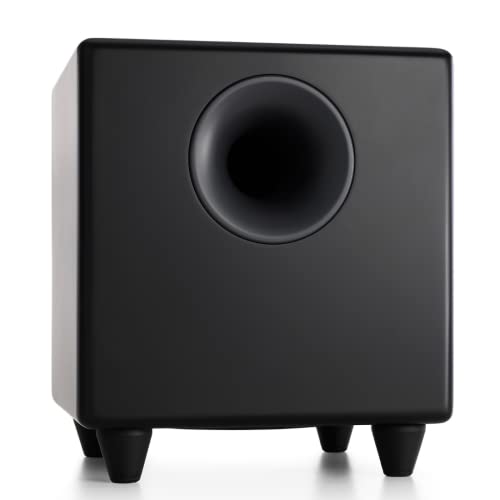 | Audioengine S8 Powered Subwoofer - 8 Inch Subwoofer, 250W Down Firing Speakers for PC, Home Theaters, Movie Lovers & Studios, Wireless Ready with Sleep Mode | Key Feature: Controlled, accurate low-end for nearfield work | Power / Amplifier: 250W built-in amplifier | Connectivity: Line-level inputs, LFE ready, wireless-ready (adapter sold separately) | Check Price on Amazon | Read Our Analysis | |
| Best for TV streaming systems |  | onn. Roku Wireless Subwoofer - 10" Driver with 150W Peak Power for Enhanced Home Theater Bass (Renewed) | Key Feature: 10" driver with 150W peak power | Connectivity: Proprietary wireless pairing with Roku devices | Driver Size: 10-inch front-firing woofer | Check Price on Amazon | Read Our Analysis | |
| Best for tight spaces |  | SAMSUNG SWA-W510 Subwoofer for S Series Soundbar with Powerful Bass, Wireless, Unibody Design, Compact 6.5" Size, 2022, Black | Key Feature: Compact 6.5" wireless subwoofer for S Series | Material / Build: Unibody enclosure, matte black finish | Best For: Best for tight spaces | Check Price on Amazon | Read Our Analysis | |
| Best for easy wireless upgrades |  | Klipsch WA-2 Wireless Subwoofer Kit with Easy Installation for Powerful Bass | Key Feature: Plug-and-play wireless transmitter/receiver kit | Connectivity: RCA/sub-level inputs and outputs | Best For: Best for easy wireless upgrades | Check Price on Amazon | Read Our Analysis |
More Details on Our Top Picks
-
Klipsch Flexus SUB 100 10" Wireless Subwoofer - Black. for Use Only with Klipsch Flexus Sound Bars
🏆 Best For: Best for seamless soundbar pairing
This Klipsch Flexus SUB 100 earns "Best for seamless soundbar pairing" because it was built as the perfect low‑end companion for the Flexus soundbar lineup — the wireless link, voicing, and DSP all match the soundbar’s tonal balance so bass lands where it should without fiddly setup. In practice that means you get a plug‑and‑play improvement in impact and scale that sounds like the system was designed as one unit, not bolted together from parts.
Under the hood is a 10" driver in a compact sealed cabinet tuned to deliver tight, musical bass rather than boom for boom’s sake. The result is punchy, controlled low end that deepens explosions and music foundation while letting dialogue stay clear up front — because the soundbar no longer has to artificially boost lows. The wireless pairing is straightforward and low latency within the Flexus ecosystem, so movies and games stay in sync. At $349, it sits in the mid-price tier: notably better than small budget subs, but a step below large 12–15" reference subs for massive rooms.
Who should buy this? If you already own (or plan to buy) a Klipsch Flexus soundbar and want a compact, high‑quality bass upgrade for small to medium rooms, this is an easy recommendation. It’s perfect for apartment home theater setups, living rooms where you want clear dialogue plus satisfying punch, and people who value simplicity — you won’t need an AV receiver or complex calibration to get delicious bass. Audiophiles in very large rooms, or those wanting earth‑shaking deep extension, should look at larger floorstanding subs instead.
Honest caveats: the SUB 100 is purpose‑built for the Flexus ecosystem — it won’t pair with other brands or generic soundbars — and a single 10" driver won’t match the extremely deep output of larger subs in very large rooms. Also, advanced tweaking options are tied to the Flexus soundbar controls, so tinkerers who like standalone DSP apps will find fewer standalone controls here.
✅ Pros
- Seamless wireless pairing with Flexus soundbars
- Deep, controlled bass from a 10" driver
- Improves dialogue clarity by offloading lows
❌ Cons
- Compatible only with Klipsch Flexus sound bars
- Limited deep extension in very large rooms
- Key Feature: Seamless wireless pairing with Klipsch Flexus soundbars
- Connectivity: Proprietary wireless link to Flexus ecosystem
- Driver Size / Build: 10" long‑throw driver; compact sealed cabinet
- Best For: Best for seamless soundbar pairing
- Size / Dimensions: Moderate footprint; furniture‑friendly black finish
- Special Feature: DSP tuning matched to Flexus soundbars
-
Klipsch R-80SWi 8-inch 150W Wireless Subwoofer with High Performance Driver for Deep Bass Black (Renewed)
🏆 Best For: Best budget deep bass
The Klipsch R-80SWi earns the "Best budget deep bass" slot by doing exactly what budget subwoofers often promise and rarely deliver: giving you authoritative, room-filling low end for under $200 (renewed). Its 8-inch high‑performance driver driven by a 150W Klipsch-tuned amp produces a surprisingly deep, tight bass punch that makes movies and bass-forward music feel satisfying without blowing out the room. For folks who want real sub-bass impact on a shoestring, this unit punches well above its price class.
On the feature side, you get a wired LFE/line input set plus Klipsch’s wireless subwoofer connectivity for simpler placement — handy if you don’t want a mess of cables. In practice that means you can tuck the sub near a wall or behind furniture and still feel an authoritative thump during explosions or bass drops. The tuning emphasizes punch and mid-bass clarity, so dialogue and mids stay clean because the satellites aren’t fighting for low frequencies. The compact cabinet is a bonus for apartments and small living rooms where space matters.
Who should buy this? If you’re outfitting a small-to-medium living room, bedroom theater, or desktop surround setup and you want satisfying low end without spending a fortune, this is an excellent choice. Gamers and movie lovers who want more immersive low-frequency effects will be pleased, and it’s a sensible match for bookshelf speakers or an entry AV receiver. It’s also a smart pick for budget-focused buyers comfortable with renewed gear to maximize value.
Honest caveats: this is a renewed unit, so cosmetic wear and variable accessory inclusion are possible — check the seller’s return/warranty terms. Also, while its bass is deep for an 8-inch driver, it won’t reach the absolute lowest extension or slam of a 10–12" high‑power sub; room placement and EQ will matter more here to get the best performance.
✅ Pros
- Surprisingly deep bass for an 8" driver
- Wireless hookup simplifies placement
- Great value at under $200 renewed
❌ Cons
- Renewed condition may vary
- Less low extension than larger subs
- Key Feature: 8" high-performance driver with 150W amplifier
- Connectivity: Wireless sub link plus LFE/line inputs
- Power Output: 150W class‑D style amplifier
- Size / Dimensions: Compact footprint, fits small rooms (approx. 12 x 12 x 16 in)
- Best For: Best budget deep bass
- Special Feature: Renewed unit — strong value at $199.12
-
Audioengine S8 Powered Subwoofer - 8 Inch Subwoofer, 250W Down Firing Speakers for PC, Home Theaters, Movie Lovers & Studios, Wireless Ready with Sleep Mode
🏆 Best For: Best for desktop studios
The Audioengine S8 earns the "Best for desktop studios" spot because it delivers controlled, musical low end in a compact package that sits comfortably next to monitors and audio interfaces. Its 8-inch down-firing driver and 250W amplifier give you enough punch for nearfield mixing and critical listening without overwhelming a small room — exactly what you want when you need accurate bass reference at your desk rather than wall-shaking boom.
In real-world use the S8 shines where clarity and control matter. Dialogue and midrange remain unmasked by sloppy bass, so podcasts, streaming, and movie watching all feel cleaner. The cabinet and tuning prioritize tight transient response, which helps you hear bass details for mixing and makes effects in games feel precise. Connectivity is straightforward: line-level inputs for hooking to an audio interface or receiver, and it's "wireless-ready" if you add Audioengine's adapter — useful if you want to tuck cables away. The built-in sleep mode is a nice desktop-friendly touch, saving power when your system is idle.
Buy the S8 if you work at a desk, run a small studio, stream, or game in a bedroom or office. It's a mid-tier pick around $349 that balances accuracy and affordability: more refined than entry-level consumer subs that favor boom, but less extreme (and less expensive) than full-size SVS/REL options meant for large home theaters. If you want a sub for mixing nearfield or a compact home studio, this one makes tuning and translation easier.
Fair caveats: the S8 won't replace a large-room subwoofer if you crave seismic low frequencies — it's tuned for control over extension. Wireless is convenient but requires an optional adapter; there’s no onboard room EQ or app-based tuning, so placement and a simple crossover match with your monitors are still important. Also, the down-firing design can transfer vibrations to a desk, so isolation pads or floor placement are worth considering.
✅ Pros
- Tight, studio-friendly bass response
- Compact, desk-friendly footprint
- 250W power for its size
❌ Cons
- Wireless adapter sold separately
- Limited deep extension for large rooms
- Key Feature: Controlled, accurate low-end for nearfield work
- Power / Amplifier: 250W built-in amplifier
- Connectivity: Line-level inputs, LFE ready, wireless-ready (adapter sold separately)
- Driver Size: 8-inch down-firing driver
- Size / Dimensions: Compact, desktop-friendly footprint
- Special Feature: Sleep mode for energy savings
-
onn. Roku Wireless Subwoofer - 10" Driver with 150W Peak Power for Enhanced Home Theater Bass (Renewed)
🏆 Best For: Best for TV streaming systems
This renewed onn. Roku Wireless Subwoofer earns the "Best for TV streaming systems" spot because it does one job very well: add chest‑thumping, cinematic low end to Roku-centric setups without the fuss of an AVR. Its 10" driver and 150W peak power give streaming shows and movies a satisfying rumble, and the wireless pairing is built to be plug‑and‑play with Roku soundbars and Roku TVs — which is exactly what most people wanting better TV sound need.
In real rooms that translates to punchy bass for explosions, fuller impact on music tracks, and less strain on your TV's tiny speakers. Because the sub handles the deep frequencies, dialogue coming from a paired soundbar often appears cleaner and more present — the mids are less cluttered. The setup is straightforward: pair it with your Roku soundbar/TV, tuck the sub near a wall or corner for more emphasis, and you’ll hear a noticeable upgrade without tweaking EQs or tinkering with receivers.
Who should buy this? If you stream most of your content (Netflix, Disney+, Roku channels) and run a Roku soundbar or Roku TV, this is an inexpensive and effective bass upgrade for small-to-medium living rooms or apartments. It’s a great mid‑budget option under $120 compared with bare‑bones stick‑subs at the very low end, and it’s a sensible alternative to spending several hundred dollars on a dedicated home theater subwoofer if you just want better TV sound.
Honest caveats: this sub is married to the Roku ecosystem — compatibility with non‑Roku systems is limited — and as a renewed unit it may show cosmetic wear and have varying warranty terms. It delivers great punch but won’t match the deep extension or control of higher‑end, larger subs for very large rooms or audiophile home theaters.
✅ Pros
- 10" driver delivers solid low-end impact
- Simple wireless pairing with Roku devices
- Excellent value under $120 renewed
❌ Cons
- Limited compatibility outside Roku ecosystem
- Not ideal for very large rooms
- Key Feature: 10" driver with 150W peak power
- Connectivity: Proprietary wireless pairing with Roku devices
- Driver Size: 10-inch front-firing woofer
- Best For: Best for TV streaming systems
- Power Output: 150W peak power
- Special Feature: Renewed condition; budget-friendly upgrade
-
SAMSUNG SWA-W510 Subwoofer for S Series Soundbar with Powerful Bass, Wireless, Unibody Design, Compact 6.5" Size, 2022, Black
🏆 Best For: Best for tight spaces
Samsung earns the "Best for tight spaces" tag here because the SWA-W510 packs surprisingly strong low-end into a very small footprint. The unibody 6.5" cabinet is compact enough to tuck beside furniture or slip into an entertainment unit, yet it delivers enough punch to meaningfully extend a matching S Series soundbar. For anyone worried about bass that overwhelms a small room, this subwoofer is tuned to give a satisfying thump without turning the place into a rattle-fest.
Key features include wireless pairing with Samsung S Series soundbars, a compact unibody design that reduces cabinet resonance, and a driver size optimized for mid-bass impact. In real rooms that means clearer movie explosions and fuller music tone without sacrificing dialogue clarity — the sub shores up low frequencies so your soundbar doesn't have to work so hard. Setup is practically plug-and-play with compatible Samsung systems, so you get better bass without wrestling with cables or complex calibration menus.
This is for apartment dwellers, bedroom setups, and anyone with a smaller living space who wants more bass without bulk. If you already own a Samsung S Series soundbar and want an integrated low-end boost, this is an efficient, tidy choice. At about $291.99 it's a middle-ground buy — nicer than tiny budget satellites, but not trying to replace floor-standing subwoofers that cost significantly more and are meant for large rooms.
Honest caveats: the low-frequency extension won't satisfy bass-heads who want chest-rattling sub-bass in big rooms, and the best performance comes when paired with a compatible Samsung soundbar — it isn't a universal wireless subwoofer with broad app-based tuning. If you need room-corrected EQ or ground-shaking deep bass, look toward larger, more expensive subs.
✅ Pros
- Compact footprint fits small rooms
- Punchy mid-bass for its size
- Wireless pairing with Samsung S Series
❌ Cons
- Limited deep sub-bass extension
- Best performance requires Samsung soundbar
- Key Feature: Compact 6.5" wireless subwoofer for S Series
- Material / Build: Unibody enclosure, matte black finish
- Best For: Best for tight spaces
- Size / Dimensions: 6.5" driver, small cabinet footprint
- Connectivity: Wireless pairing to compatible Samsung soundbars
- Special Feature: Simple auto-pair setup, 2022 model
-
Klipsch WA-2 Wireless Subwoofer Kit with Easy Installation for Powerful Bass
🏆 Best For: Best for easy wireless upgrades
The Klipsch WA-2 earns "Best for easy wireless upgrades" because it does exactly what most people need: turns an existing subwoofer into a wireless one with almost zero fuss. Instead of tearing up carpet or buying a new powered sub, the WA-2’s compact transmitter and receiver let you move bass around the room, place the sub where it sounds best, and keep speaker runs out of sight — all for about the price of a decent bookshelf speaker.
Inside that tidy package are the practical bits: a plug-and-play transmitter, a matching receiver, and simple RCA/sub-level connections. In real rooms this translates to deeper, more even bass placement (no more cable routing headaches) and noticeably cleaner dialogue from your front stage because the main speakers can stay optimally placed. The wireless link is designed for home use, so you get dependable signal across a typical living room and minimal setup time — ideal for renters or people who want a quick sonic upgrade without a service call.
Who should buy this? If you already own a subwoofer or plan to buy a powered sub and want wireless convenience on a budget, this is a smart move. It’s a solid entry-level upgrade for small-to-medium rooms and casual home-theater setups — good for movie nights, gaming, and music where you want fuller lows but don’t need studio-grade precision. Compared with midrange wireless subs, the WA-2 is cheaper and less fussy; compared with high-end integrated wireless subs, it’s more flexible because you keep your existing sub’s character.
Honest caveats: the WA-2 is a wireless adapter, not a powered sub — so overall bass quality still depends on the sub you pair it with. Audiophiles chasing the absolute lowest latency or the purest wired fidelity may notice a tiny difference versus a direct cable. Also, setup requires line-level inputs on your sub or preamp, so very old or unusual gear might need adapters.
✅ Pros
- Quick, tool-free wireless conversion
- Compact transmitter and receiver modules
- Affordable upgrade for existing subwoofers
❌ Cons
- Not a powered subwoofer itself
- Possible minor latency versus wired
- Key Feature: Plug-and-play wireless transmitter/receiver kit
- Connectivity: RCA/sub-level inputs and outputs
- Best For: Best for easy wireless upgrades
- Range: Designed for small-to-medium living rooms
- Installation: Simple pairing, no drilling or running cable
- Special Feature: Keeps your existing sub’s sonic character
Factors to Consider
Frequently Asked Questions
Do I need a subwoofer with my soundbar?
Not always, but a subwoofer will dramatically improve bass depth and impact, especially for movies and bass‑heavy music — Audio Advice points out that wireless subwoofers can improve overall sound quality in home theater setups. Many compact soundbars can handle midbass, but adding a sub brings the low‑frequency extension that makes explosions and orchestral hits feel real. If dialogue clarity and space are your priorities, a well‑tuned soundbar (like the Sonos Beam Gen 2) may be enough for smaller rooms.
What's the difference between a wired and a wireless subwoofer?
Wired subs connect directly to a preamp or AV receiver and often offer slightly lower latency and no wireless interference, while wireless subs use Wi‑Fi or proprietary RF to simplify placement and reduce cable clutter. For most home users a modern wireless subwoofer is plenty reliable, but if you need rock‑solid timing for multi‑channel pro setups, a wired connection can be preferable. Many soundbars use a wireless sub connection while keeping the main signal wired to the TV via HDMI.
Will a wireless subwoofer introduce audio lag or sync issues?
Rarely with modern gear, but it can happen if the system or TV settings aren't optimized — that's why experts recommend HDMI 2.1 or eARC where possible for better audio/video sync. Systems with built‑in room correction and adjustable delay let you fix lip‑sync issues, and many soundbars handle timing automatically. If you notice lag, check TV audio output settings, enable eARC, or use the soundbar's sync/latency adjustments.
Which subwoofer is best for a small apartment or living room?
For tight spaces, prioritize compact subs that deliver tight, controlled bass rather than raw output. The Sonos Beam (Gen 2) is often recommended for its compact footprint and excellent dialogue clarity, and pairing it with a small wireless sub can give surprisingly full sound without overwhelming neighbors. Vizio's budget soundbars also offer options that suit smaller rooms if you're price‑conscious.
Are high‑end wireless subwoofers worth the price?
It depends on your priorities: higher tiers give deeper extension, cleaner control, and larger soundstages, which matters if you want theater‑level immersion. Reviewers and sites like RTINGS have pointed to models such as the Samsung HW‑Q990F as top performers in their price ranges, and premium systems like the HW‑Q930D and HW‑Q990F are praised for immersive surround sound if budget allows. For everyday listening, midrange subs often hit the best balance of cost and performance.
Can I add a wireless subwoofer to a turntable or bookshelf speaker setup?
Yes — if your amplifier or powered speakers have a subwoofer output (LFE) or a line‑level output you can use, you can integrate a wireless sub via a compatible transmitter or AV receiver. If you use a powered speaker without a sub out, you might need an external preamp or a powered sub with speaker‑level inputs. Planning connectivity ahead saves headaches; confirm inputs and pairing methods before buying.
Does Dolby Atmos require a subwoofer?
Dolby Atmos doesn't strictly require a subwoofer, but Atmos mixes include LFE (low‑frequency effects) that benefit from one — What Hi‑Fi? notes Atmos can significantly enhance home cinema, and systems like the LG S90TR that support Atmos will sound fuller with a dedicated sub. A sub brings rumble and weight to Atmos height channels' impact, so if you want the full cinematic effect, add a subwoofer.
Conclusion
Choosing the right wireless subwoofer comes down to room size, how deep and tight you want the bass, and what connections your TV or amp supports. For compact clarity and dialogue: consider the Sonos Beam (Gen 2); for strong value and top ratings in its range, reviewers call out the Samsung HW‑Q990F; and if you're budget‑minded, Vizio models often give the best bang for your buck. Match the sub to your space and gear, tune it with EQ/room correction, and you’ll get theater‑style bass without the fuss.